01 / the making
realization
Technique
The work is composed of two structural platforms built around a load-bearing grid of fir timber, using slats with a cross-section of 18 × 4 cm. Phenolic plywood panels laid over the timber form the technical surface of the installation. Natural turf is placed on these panels, creating a continuous surface that provides the base for the planting composition.
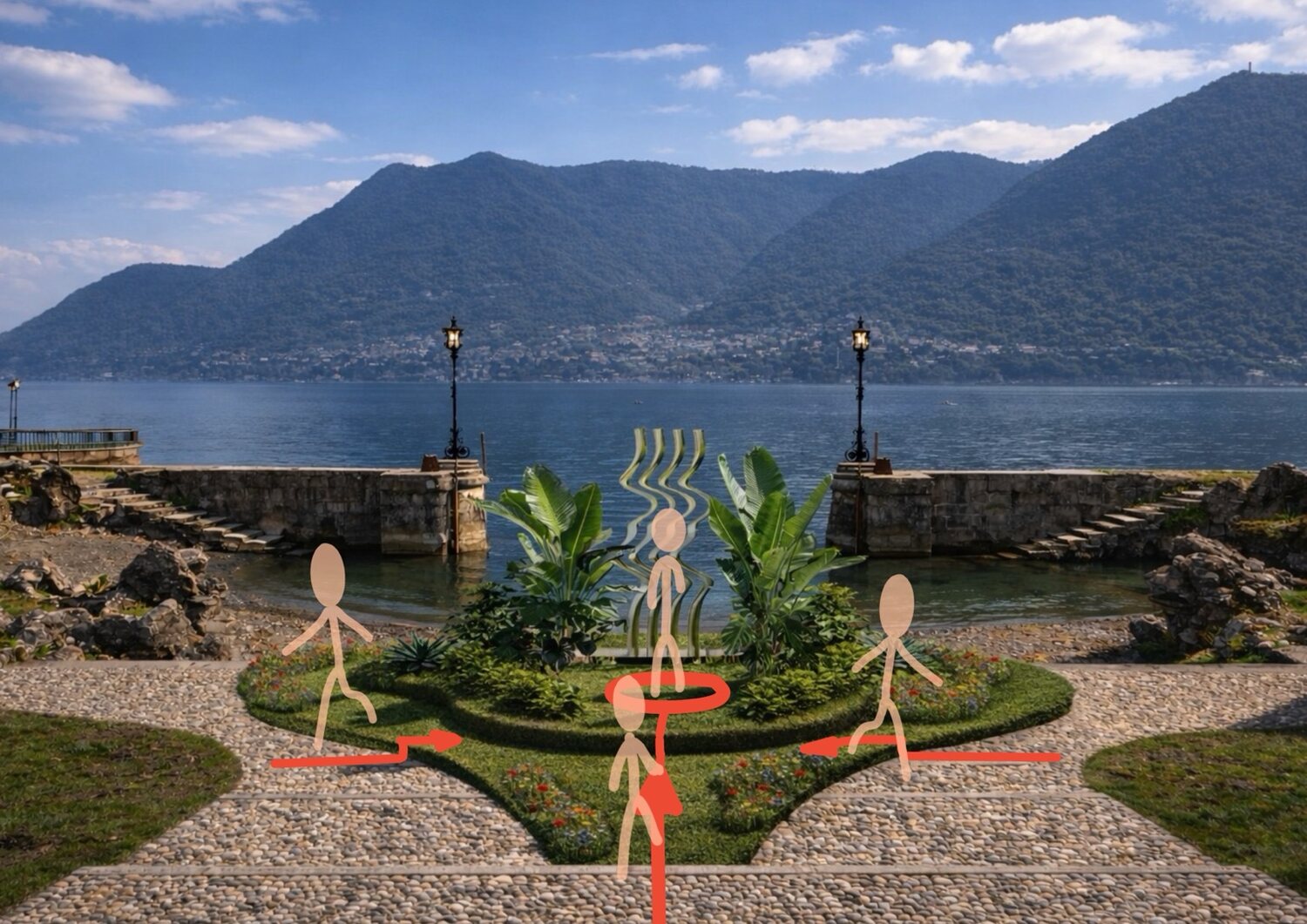
Together, the two surfaces create an ascending spatial sequence: the first level appears as a continuous planted plane, while the second introduces a more vertical, theatrical dimension, accommodating the planting composition and the sculpture.
The central element, “La cascata che sale” (The rising cascade), was designed by Mindshapes and Stefano Turconi under the guidance of Totum 3D, the production partner that supervised the process and engineering through 3D printing technology.
The production technology was chosen to minimise the overall footprint of the process, reducing the use of external processing equipment, energy consumption and materials. 3D printing makes it possible to produce complex geometries directly, optimising material use and integrating three-dimensional lattice structures within the work to provide structural strength while keeping its overall weight down. Materials and processes are also selected according to the performance required of each component, balancing efficiency, strength and aesthetic quality.
Once printing and assembly were complete, the sculpture received a reflective chrome finish. This allows its surface to enter into a dialogue with the light, the lake and the surrounding landscape, evoking water in an abstract, dreamlike dimension.
02 / the idea
concept
A dreamlike dimension takes shape through the dialogue between art and botany. This is Mimesi del sogno: an immersive experience of ascent towards a deeper understanding, where forms, colours and movements expand our perception of reality.
From ground level to the dream state, the platforms become instruments of elevation. The artwork unfolds as a living, interactive path: to ascend is to shape a new vision.
The installation’s sinuous lines, or shapes, evoke natural patterns and gestures connecting humanity and nature. They suggest descent and ascent at once: the dream seems to descend from above through a dialogue of reflections, opening a subtle passage between the real and the surreal.
The artwork creates the conditions for stirring the imagination, establishing an exchange between viewer and environment. Earth and sky communicate through the cascade, a bridge into the dimension of dreams.
The first platform holds a meadow inhabited by species traditionally associated with the dream world, guardians of imagination, memory and vision. The second leads into the heart of the dream: lush, enveloping tropical vegetation inspired by the suspended worlds of Henri Rousseau, where nature becomes narrative, apparition and wonder.
What appears remote or exotic today may become part of the everyday landscape, revealing how the boundaries of the possible are already shifting. From this perspective, the dream is not only imagination but anticipation: a lens through which to observe change and the inevitable migration of tree species, inviting us to reflect on how balances—and our relationship with them—will evolve.